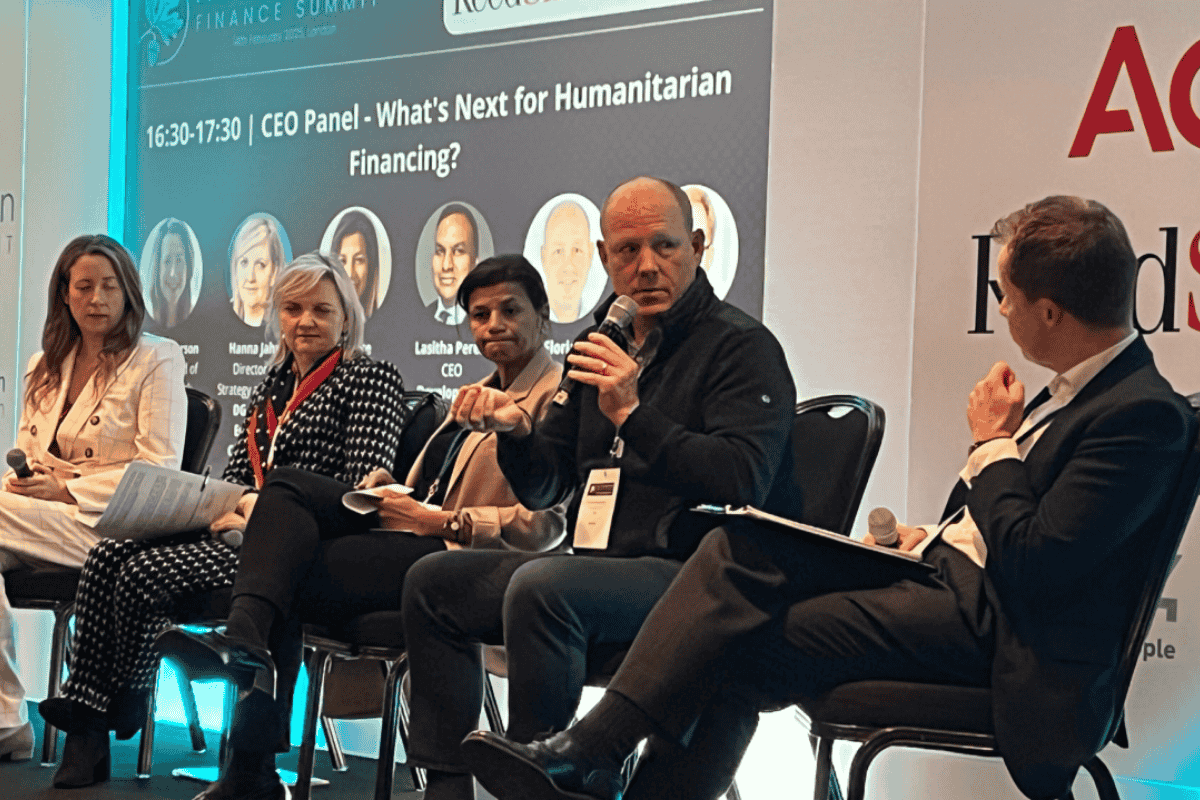
On stage yesterday – Valentine’s Day – at the Humanitarian Finance Summit in London yesterday, I found myself grappling with a deep sense of unease. The conversations around me were steeped in familiar technical discussions – financing mechanisms, risk mitigation, investment vehicles – without taking into account that the fundamentals had shifted entirely. The collapse of USAID and the evaporation of $40 billion in funding overnight was not just another policy change. It was an earthquake whose tsunami will ripple across the entire humanitarian and development sector as it is just the beginning. Global corporations and financial institutions are forced to abandon ESG and DEI initiatives due avoid retaliation from the new US government. Even I see many of them needing to leave SFDR regulations to protect themselves and their businesses. And yet, in that room, it felt like business as usual.
Here I couldn’t ignore the disconnect. The polite discussions about solutions felt detached from the reality unfolding before us. I spoke up, candidly and emotionally, because it was impossible not to. I have been here before. I have seen this pattern repeat itself. And this time, the consequences will be far more severe.
Living in Geneva, I had witnessed the first déjà-vu moment in 2018, when Trumponomics 1.0 – though less abruptly – cut funding to multilateral and development organisations, many of which are based on the rive droite (right bank) of the city. These institutions, long accustomed to the stability of public financing, were suddenly forced to rethink their entire funding model. They needed to engage the private sector, to build bridges to the rive gauche (left bank), where financial institutions and trading powerhouses shape the global economy.
At the time, there was a rush to launch blended finance solutions, public-private partnerships designed to attract private capital into development efforts. I was personally involved in ten of them. Some never made it beyond the conceptual stage. Others launched but faltered, and a few gained traction only to be disrupted by COVID-19 in 2020 and the financial uncertainty that followed. The moment had felt like an opportunity for systemic change, but in the end, too many initiatives remained half-measures, unable to fully transition humanitarian aid into an investable, scalable system.
The second déjà-vu moment was even starker. In early 2020, when the pandemic was still “far away” in China, life in the rest of the world carried on. Football stadiums were packed. Conferences were full of handshakes and optimism. People were doing business as usual, blind to the wave that was about to crash over them. Then, almost overnight, lockdowns were imposed, hospitals overflowed, and entire economies came to a standstill.
The earthquake that started “far away” in Washington, D.C., with the implosion of USAID, is no different. The tsunami is coming. And this time, it won’t just hit humanitarian aid organizations. It will sweep across the entire global development finance ecosystem. We are witnessing the rapid collapse of traditional humanitarian structures, and with it, the loss of institutional knowledge, on-the-ground expertise, and support systems for the most vulnerable communities.
Organisations are already laying off their staff. Some are shutting down altogether. Others, desperate to find alternative funding models, are reaching out to the private sector, recognizing that impact investing and blended finance may now be their only viable path forward. At the same time, global corporations and institutional investors, under increasing pressure, are abandoning their commitments to ESG and DEI, further complicating the landscape.
This is the defining moment. If the development sector is to survive, we must move beyond the old paradigm of “poverty uplift” and political soft power. The traditional donor-driven model is no longer sustainable. Instead, we need economic empowerment with real investments that create lasting change.
It is not enough to simply replace public funding with private capital. We must build investable and insurable solutions that can operate at scale. Governments must create an enabling environment. Financial institutions must develop innovative instruments to de-risk investments. Investors must embrace a new mindset, one that sees impact not as a trade-off, but as a fundamental driver of returns. And most importantly, communities on the ground must no longer be seen as passive recipients of aid, but as partners and entrepreneurs in their own economic transformation.
I do not write this to paint a doomsday scenario, but to issue a call to action. The collapse of USAID is not just another funding cut. It is a global reset. If we fail to act now, we will see decades of humanitarian progress unravel. But if we rise to the challenge, if we finally bridge the gap between philanthropy and investment, we have the opportunity to build something better.
No one wants to be helped. No one wants to be pitied. What people want is a chance to build their own future.
This is why I believe in impact investing. This is why I have dedicated my professional life to save meaningful organisations and designing financial mechanisms that generate returns while transforming lives. This is why I stand by my guiding principle: “Impact lives, share profits.” Now is the time to make it real !
Read the article on Linkedin here.