At 33, I had everything I was told to want: a great education, a beautiful family, financial security, and my dream job of running a company. And yet, a quiet question kept tapping my shoulder: Is this all there is? About that dissonance I wrote 10 years ago in “Why is Education Not Vocational?”, realising my dreams had somehow turned into duties with energy-draining boxes to check rather than a life to live.
Looking back, I now see the core problem: “It was the me being absent subject of my own education”. Being trained brilliantly to “make a living,” but not to “live my life”, to know my values, my vocations, my contributions. Education had given me answers to other people’s questions, with the tools to ask my own.
As I have learned over countless sessions that this is not just my story. As I explore in my “soon to be published” work, education as we have built it, often forgets its most essential subject: the human being. Years ago I learned this powerfully from Colombian choreographer Álvaro Restrepo and his Colegio del Cuerpo: “Education doesn’t serve us anything… only if it helps us to discover who we are.” That simple sentence unlocked a truth I wish I had heard at 16, not 36.
When we are the “absent subject,” we master technique, but miss meaning. We accumulate skills yet stall on purpose. We learn how to deliver performance, not how to pass the mirror test. And without purpose, even success can feel strangely hollow. Viktor Frankl warned us:
“Life is never made unbearable by circumstances, but only by lack of meaning and purpose.”
Purpose is not a nice-to-have; it is actually our operating system. Simon Sinek’s invitation to Start With Why echoes the same:
“If we don’t know our “why”, the “what” will grind us down.”
The world of work has been rewritten. As my dear YPO friend and CEO of Junior Achievement Worldwide, Asheesh Advani, puts it:
“The future of work is no longer about what you do but about why you do it.”
Technical skills still matter, but they are table stakes and increasingly automated. What differentiates us now is clarity of purpose and the human capacities around it: empathy, judgment, collaboration, and courage to act, or in short: EQ over IQ.
AI has also lowered (and in many cases, eliminated) the barriers to create, innovate, and scale. That is thrilling and sobering. Thrilling, because the tools to prototype, launch, and build are within reach for anyone with a good problem and grit. Sobering, because if our education remains non-vocational, without forming character, purpose, and ethical imagination then we will automate our blind spots, not our breakthroughs.
Here my YPO friend and Founder & CEO of World Leaders in Data and AI [WLDA], Asha Saxena, reminds me of the stakes:
“AI can amplify human potential, but it can also encode bias at scale when diverse voices and values are missing from the table. Teaching AI without teaching purpose and responsibility is not education, it is acceleration without a steering wheel.”
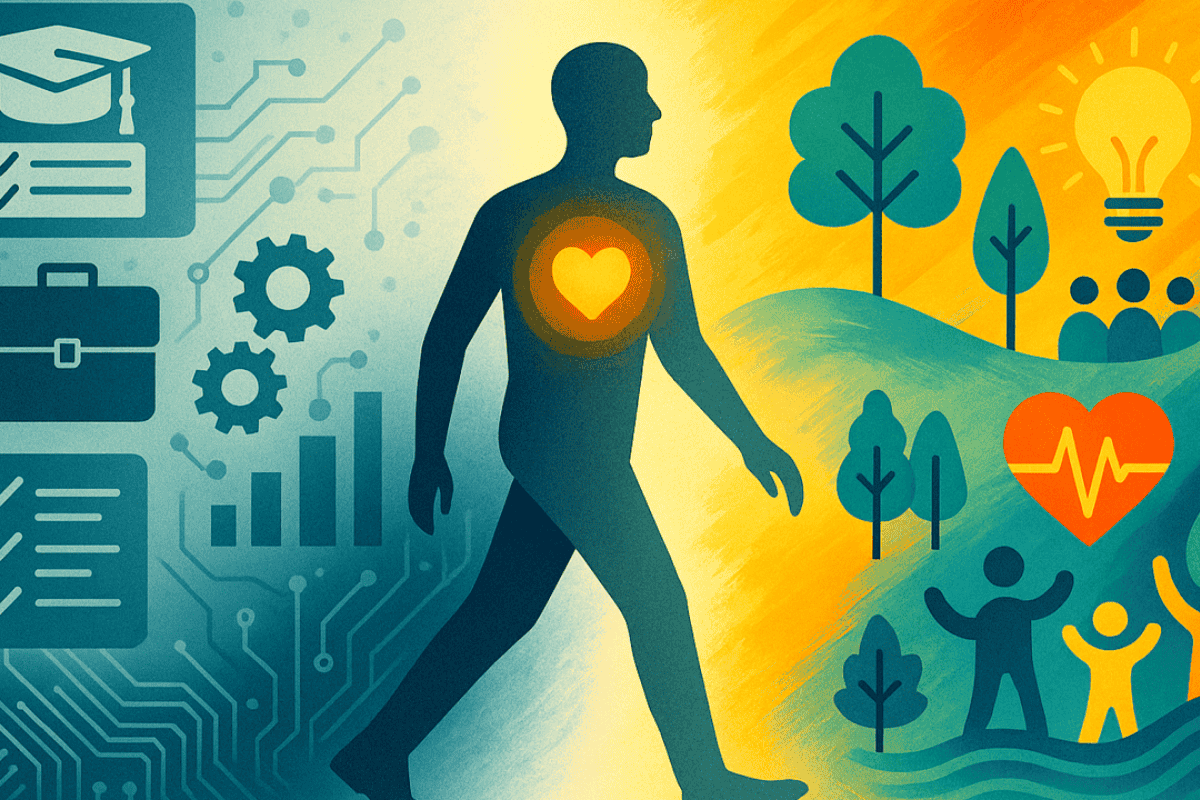
In my writing, I use the verb “vocating” as the ongoing practice of aligning your profession with your purpose. Not a noun to “have”, but a path you do. It is a seven-step process that starts inside (Who am I? What do I care about?) and moves outward (Where can my skills serve real needs? How do I measure the impact?).
Crucially, “vocating” develops emotional intelligence, self-awareness, self-regulation, empathy, social skills being the very muscles that AI can’t replicate (for the time being) and modern leadership can’t live without. These aren’t soft skills; they’re “make-or-break” skills for vocational success and team trust. Purpose research backs this up: purpose correlates with better health, resilience, and even longevity. So, it is actually measurable, instead of mystical.
My turning point wasn’t a TED Talk. It was actually pain. I had “won” by the old scoreboard, but I felt empty. So I started asking me more meaningful questions:
- Why am I doing this?
- What impact do I want to create?
- Who am I beyond the roles I play?
Those questions didn’t make life tidier; they made it truer. They led me from “helping” to “empowering“, from short-term charity to long-term impact investing, and to my personal leitmotif: “Impact lives, share profits”. As I often say:
Give a person a fish and you feed her for a day; teach her to fish and you feed her for a lifetime; invest in her fishing business and you empower the livelihood of her entire community.
That’s vocation in action. If we want education to prepare people for a world shaped by AI (and climate, and geopolitics, and inequality), then education must become vocational in the deepest sense: Not “trade school,” but vocation school. That means:
- “Self-knowledge” is a core subject where students graduate fluent in who they are by their values, strengths, triggers, and aspirations. Not just in calculus and code. We are no longer the absent subject.
- “EQ as a performance skill” to practice empathy, collaboration, and ethical decision-making with the same intensity we practice math. These are the human edges that AI can’t automate and that great teams rely on daily.
- “Purpose-to-profession design” to teach people to map their “why” to real-world problems and build ventures, roles, or careers around that alignment. To measure impact, not only income.
It is not my intention to critique schools, but to complete them. To help anyone step into a life where making a living and making a difference are the same path.
Over the coming weeks I will share more of the framework I have been using with leaders, founders, and students worldwide to help them to “vocate” by to aligning purpose with profession and building a life they recognise as their own. In an age where AI accelerates whatever we point it at, we need to point it at the right “why”.
Because when we are finally present in our own education, we don’t just work differently, as we finally live differently. And that’s the point.
“Impact lives, share profits”
PS: If any part of this resonated, drop a line below: “What would it look like for you to stop being the absent person of your own education?”
Read the article on Linkedin here.